
AI agents vs. chatbots: what your company actually needs in 2026
Author
Patrik Sabol
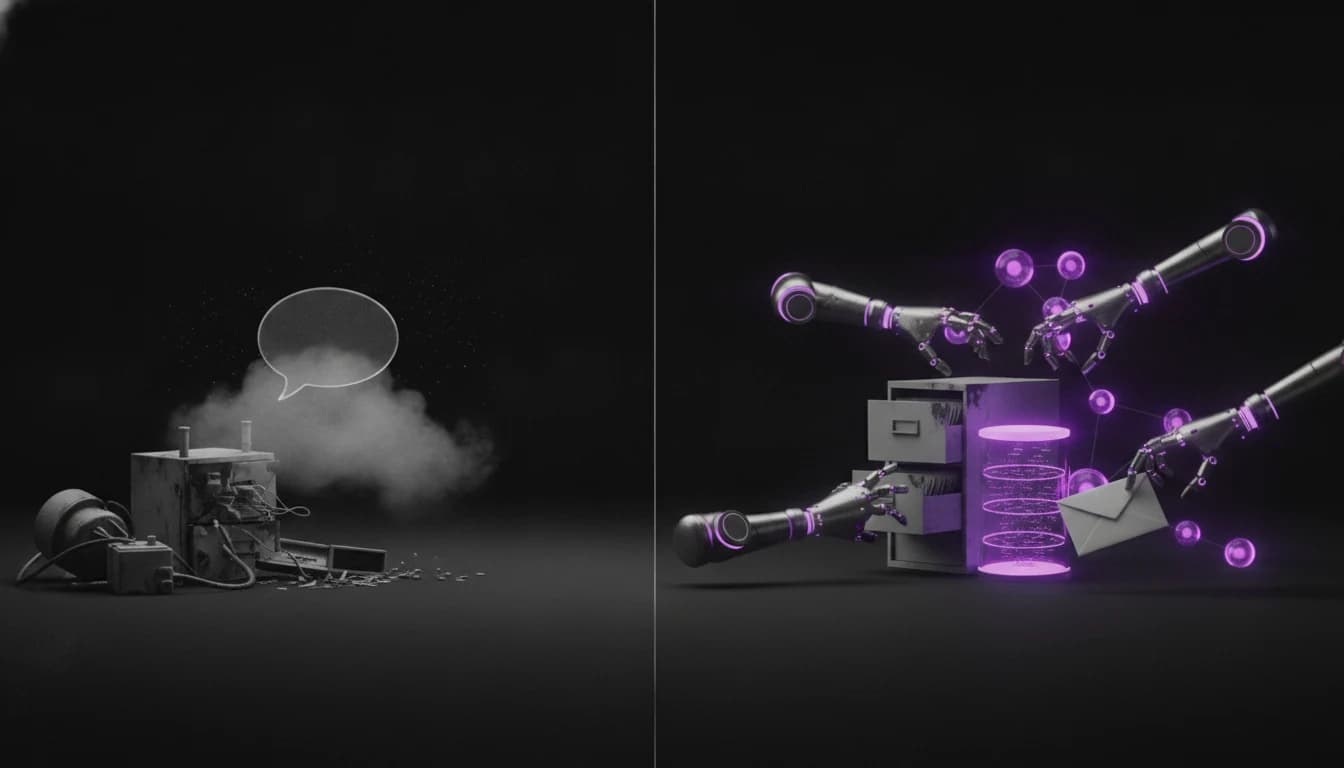
Over the past year we have heard “chatbot” and “agent” used interchangeably about a hundred times. They are not interchangeable, and the difference costs money in both directions. A company that needs an agent and buys a chatbot finds out six months later that nothing was saved. A company that only needed a chatbot and built an agent paid three times more than it had to.
Let us break it down so you can actually decide.
A chatbot answers. An agent acts.
A chatbot receives a question and generates an answer. It can be very good — it can search your documents, remember conversation context and cite sources. But the output is always text for a human. Whatever happens next is done by a person.
An agent receives a goal and has tools available. It does not generate an answer — it executes a sequence of steps: reads the email, calls the inventory API, creates the order, drafts the reply. Between steps it decides based on what the previous step returned.
In practice this means one thing: an agent must have access to your systems. Without that, it is a chatbot with ambitions.
When a chatbot is enough
A chatbot is the right choice when the bottleneck is finding information, not processing it:
- Colleagues repeatedly ask about the same internal rules and procedures.
- Customers ask about shipping, returns and product specifications.
- A new team member needs a month to find their way around the documentation.
The return is straightforward here: how many hours a week do people spend looking for something that already exists in the company? If it is a few hours per person, a chatbot over your own documents pays back quickly and can be built in weeks.
One thing matters: the chatbot must cite its source. An answer without a source is unusable in a corporate setting — it cannot be verified and it cannot be defended.
When you need an agent
An agent makes sense when a person is not making a decision but performing a transcription. Typically:
- Orders arrive by email and someone retypes them into the ERP.
- Invoices arrive as PDFs and someone keys in the line items.
- A ticket comes into support and someone manually looks up the order status.
The common thread: the input is semi-structured, the rules are known, and the result is a write into a system. That is exactly the work an agent handles — and the work people dislike doing.
Why Zapier and Make are sometimes not enough
This is the most common objection and it is a fair one. If a process can be described as “when this arrives, do that”, classic automation is cheaper, faster and more reliable. Do not reach for AI while you have a deterministic problem.
The difference appears with input variability. A Make scenario breaks when:
- the same customer writes the order differently every time,
- the attachment arrives once as a PDF and once as a phone photo,
- the email contains a note saying “and add two more of what we had last time”.
Classic automation needs a fixed shape. An agent copes with a shape it has not seen before — and that is the only reason to pay more for one.
Three things agents fail on in practice
Over the past year we have seen enough stalled projects. Almost always on one of these.
1. The agent has nowhere to hand a case off to. If the agent must decide even where it is unsure, it starts inventing. The fix is not a better model but an explicit “I do not know” state and a queue for a human. A good agent hands off 10–30% of cases, and that is fine.
2. Nobody measures accuracy. Without a test set, development turns into guesswork. You change a prompt, one thing improves, another quietly breaks, and you find out from a customer. A test set of 30–50 real cases with the correct outcome is the minimum you can work with.
3. The agent is allowed too much. If the agent may email customers and delete records, sooner or later it will do so wrongly. Outward-facing operations belong behind human confirmation — not because a model could not handle them, but because the cost of an error is asymmetric.
How to decide in ten minutes
Take one concrete process and answer:
- Is a person making a decision, or just transcribing? Transcription → agent. Decision → more likely a chatbot as decision support.
- Does that process have an API or a database? No → start with a chatbot; an agent will be expensive.
- How many times a month does it happen? Under 50 → probably neither pays off.
- Can we say when the output is correct? No → find that out first, otherwise nothing can be measured.
If the answer is an agent, start with one process. Not three. A pilot spanning three things never finishes — we have seen that often enough to write it this bluntly.
Summary
A chatbot solves access to information. An agent solves working with it. Most companies that approach us need the first one first — and it is only fair to say so before the second one gets built.
If you are not sure where you stand, the AI readiness quiz will show you in three minutes what makes sense as a first step.
What could you automate?
You do not need to know whether you need an AI agent, automation or a systems integration. Describe the process that slows you down the most — we will tell you what can be automated and whether it pays off.
Talk to us — and if AI would not pay off in your case, we will tell you straight.
Talk to us about your process