
Wholesaleexample use case
Automating email orders into your ERP with AI
Orders arrive by email — in the body, as a PDF, in a spreadsheet, on a phone photo. Someone retypes them into the system every day and the errors surface at dispatch. An AI agent takes over that work and leaves people only the cases it is not sure about.

Sound familiar?
- One or two people spend hours every day retyping orders from emails into the ERP.
- Every customer orders differently: free text, their own spreadsheet, a PDF from their system, a photo of a delivery note.
- Typos in codes and quantities are found in the warehouse or by the customer — when they cost twice as much.
- You tried rules or Make and Zapier, but the scenario breaks on every deviation from the template.
How it works
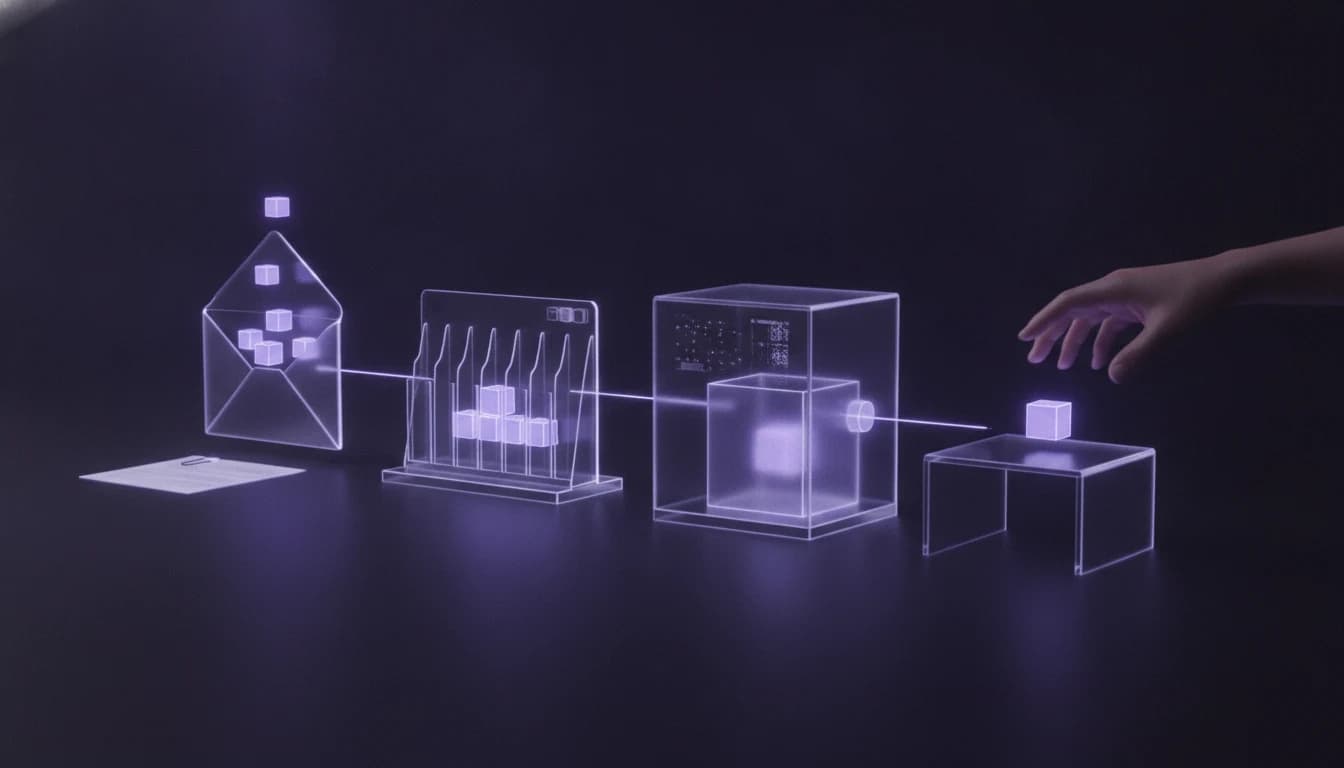
1. Reads the email and the attachment
The agent processes the message body and any attached PDF, Excel, image or scan. From each it extracts line items, quantities, delivery date and address.
2. Matches items to your catalogue
Customer names and codes are mapped to your stock items — even when the customer writes “same as last time” or uses their own labels.
3. Checks stock and prepares the order
Over API or MCP it asks the ERP for availability and price, creates the order and drafts a confirmation for the customer.
4. Hands exceptions to a person
Unknown item, price mismatch, missing date: the agent does not flip a coin. It flags the case and sends it to the approval queue.
What the system handles
- Free-text emails in Slovak, Czech and English.
- Attachments: PDF, Excel, Word, images and scans (OCR as a fallback for poor quality).
- ERP and warehouse connections — typically Pohoda, Money, Helios, SAP Business One or a custom system — via API, database or MCP.
- Orders with multiple delivery addresses, partial deliveries, notes like “and please add…”.
- Order confirmation to the customer — first as a draft for approval, later automatically if you choose.
Human oversight and safety
- Starts in “propose, human approves” mode: the agent prepares the order, a salesperson confirms it with one click.
- Control is released gradually — only for order types where the agent shows stable accuracy on the test set.
- Every decision is logged: you see which email and which attachment line produced which item.
- You set the confidence thresholds. For large amounts or new customers, approval can stay permanent.
What result is realistic
~70%
of orders handled without a human
For a typical wholesaler with dozens of orders a day we plan for roughly 70% of orders processed without a human. The rest is approved in seconds rather than minutes. With two people and two hours of retyping a day that is around 80 hours a month — production rollout typically pays back within about a year, plus fewer complaints caused by typos.
The figures are indicative for typical volumes. We give a precise estimate for your company after analysing the process.
Indicative scope
- Process analysis and order sample
- €900 – €1,800
- Pilot on your real emails (2–4 weeks)
- €3,500 – €7,000
- Production rollout with ERP integration
- €6,000 – €15,000
- Operations, monitoring and evaluations
- from €390 / month
Prices are indicative and exclude VAT. We give an exact figure only after analysing your process — not off the cuff on the first call.
Frequently asked questions
What if a customer sends an order in a completely new format?
The agent does not work with templates but with meaning. It usually handles a new format; if unsure, it hands the case to a person and you see where the problem was. Such cases are added to the test set so they are handled next time.
Do we have to change our ERP?
No. We connect to what you use — via API, directly to the database or through an MCP server. If the system has no API, file import works too.
From how many orders a day does this make sense?
Roughly from 15–20 orders a day, or fewer if orders are long and retyping takes time. We count it together on the first call — and if it does not pay off, we tell you.
Where does customer data go?
Your choice: EU regions of the major model providers with a contractual ban on training on your data, or a smaller model running on your premises. We explain the difference in price and accuracy up front.
How long until it actually runs?
A pilot on real emails in 2–4 weeks. Production rollout with ERP integration usually 6–10 weeks from the start.
Related service
AI agents & automation
We build this solution as part of our service „AI agents & process automation“.
An agent that processes emails, orders and invoices instead of your teamRead more
- How to automate order processing from email: rules, Make or an AI agent?Orders arrive by email as text, PDFs and spreadsheets, and someone retypes them into the ERP every day. Three ways to automate it, where each one breaks — and what you need ready before you start.
- AI agents vs. chatbots: what your company actually needs in 2026A chatbot answers. An agent acts. The difference is whether AI can see your systems and do something in them — and that is exactly where the return is decided.
- How much does an AI solution cost — and where budgets get burnedReal price ranges for an audit, a pilot and a production rollout, monthly running costs, and five places where companies most often spend money for nothing.
More solutions
 Accounting
Automated invoice and delivery note processing with AI
< 3 months · typical payback period E-commerce
AI customer support automation — without the risk of AI sending nonsense
~40% · shorter first-response time Distribution
Email automation: a shared inbox that sorts itself
~80% · of emails sorted and routed without a humanIf you can say how many hours a week someone spends retyping orders, we have a number to start from.
You do not need to know whether you need AI, automation or a new system. Show us the process that slows you down — we will tell you what can be automated and whether it pays off.