
B2B SaaS · AI in supportexpiro.sk · live since 29 September 2026
Expiro: AI that guesses what is bothering the customer
Expiro tracks technical inspections, emissions checks, insurance and motorway vignettes for company cars. We designed and built its AI part; the web and the mobile app come from our Grow-App studio. Here is where AI helps in the product, where we deliberately kept it out, how we measured it and what it costs.
- situations in the pre-launch test
425
situations in the pre-launch test
- of problems among the first three suggestions
94%
of problems among the first three suggestions
- median AI response time
0.29 s
median AI response time
- per thousand openings of the AI panel
$0.11
per thousand openings of the AI panel
The challenge: an annoyed customer does not write, they leave
Expiro does one thing. A company pastes in its licence plates, the service looks up the dates in the register and sends a reminder before each one. A missed technical or emissions inspection costs a company a €165 fine for each.
Register data sometimes lags, though. A fleet manager sees a van marked “overdue” although it passed its inspection last week. They will not write to support. They close the app and do not open it again.
A subscription service starting at €4.90 a month cannot afford a person who reads, sorts and answers every message. The goal was for customers to solve most problems themselves with one click, and for the rest to reach support already sorted.
Expiro in a minute and a half
The solution: four suggestions instead of an empty form
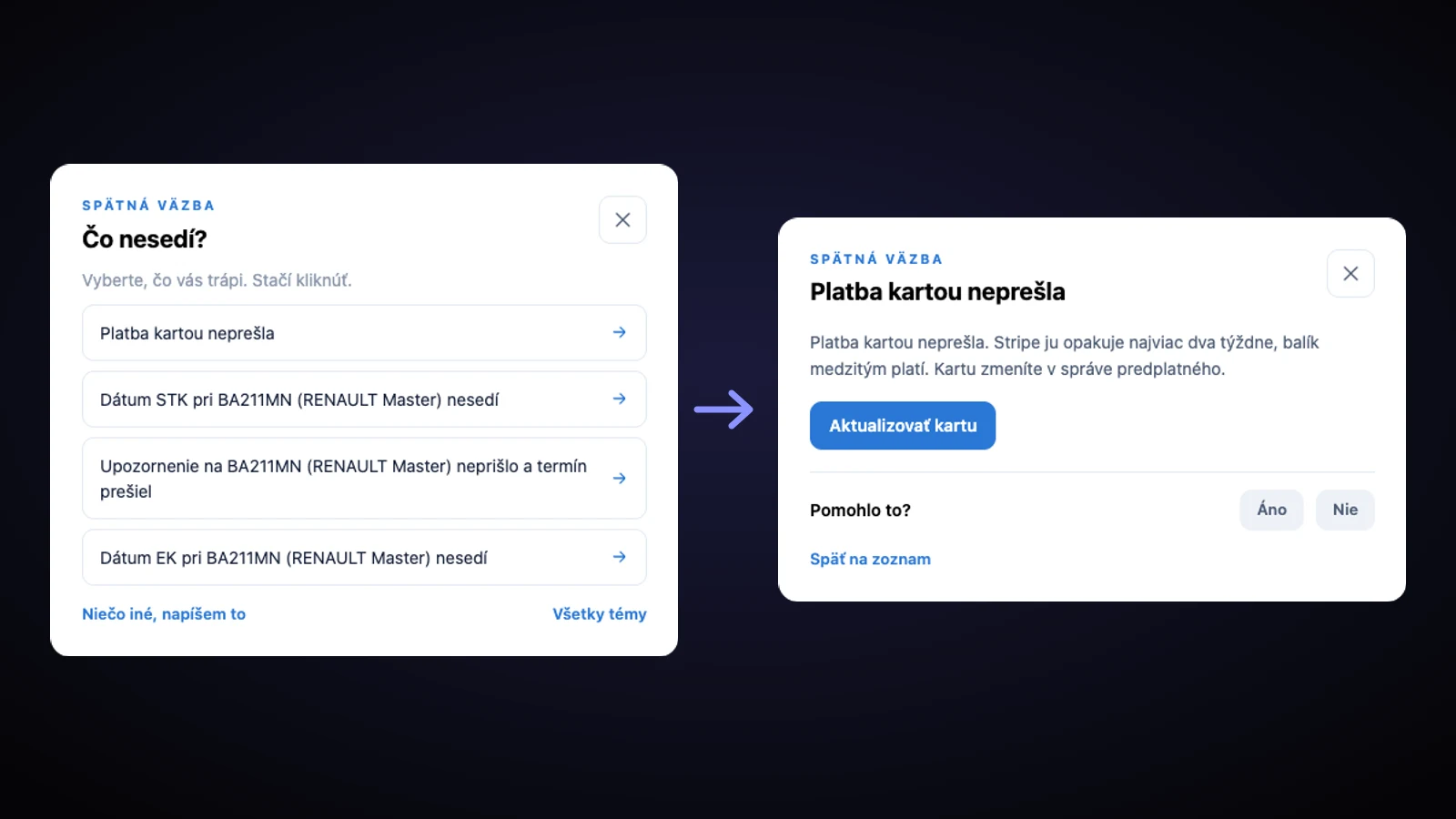
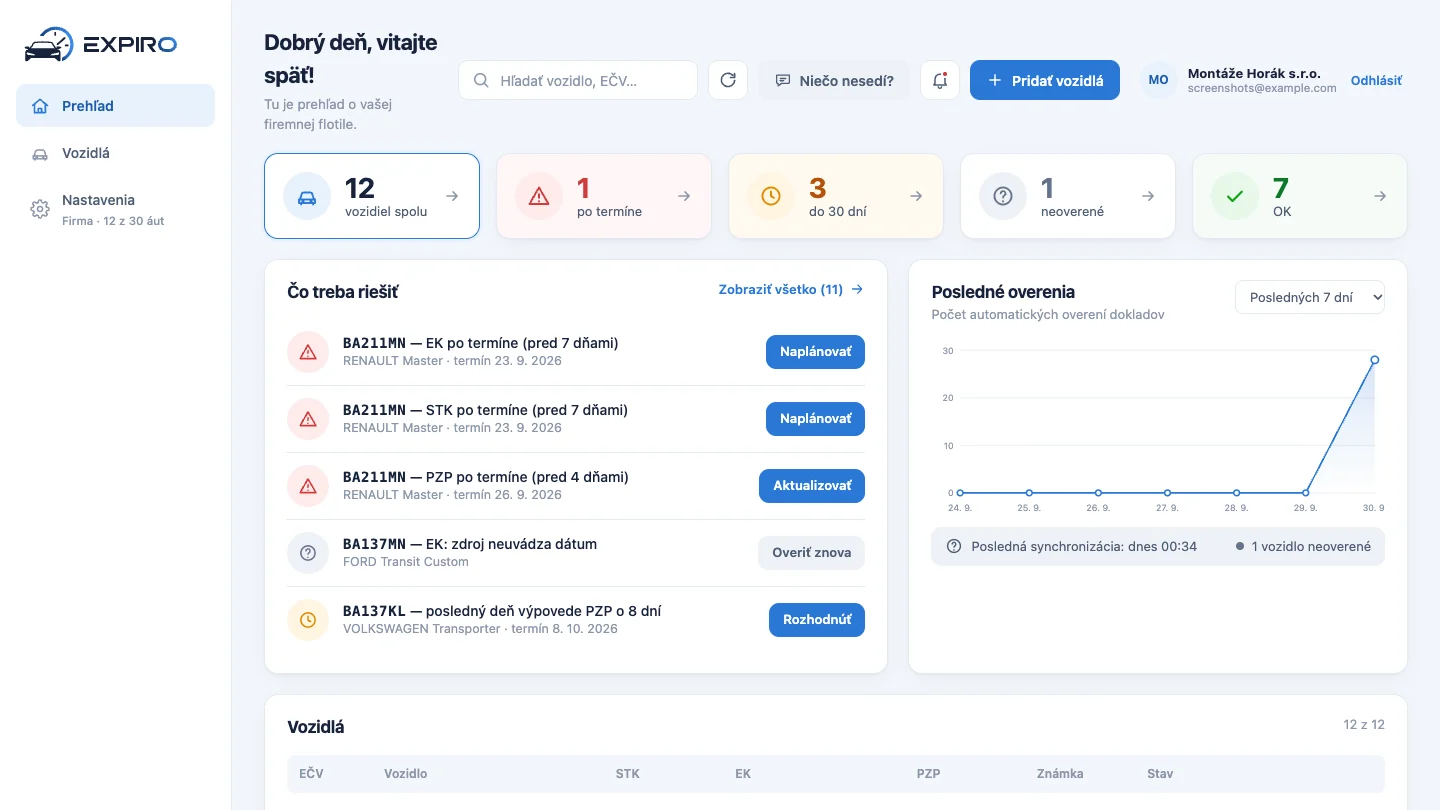
1. A click on “Something wrong?”
The button sits in the top bar, next to every car and next to error messages. The deadline email has a “Date is wrong” link right next to each car.
2. The four most likely causes
Out of more than 50 prepared problems, the ones that fit the company and what the customer was just doing are picked: an overdue car, a failed payment, three clicks on “Check again”.
3. A one-click fix
Each suggestion has an explanation and a button: enter the date manually, remove the car, update the card. Then the question “Did this help?”.
4. The rest reaches support already sorted
Whatever cannot be fixed on the spot arrives by email with the car and the context. For serious matters, such as a fine, a person replies within 24 hours.
Where AI is used and where it deliberately is not
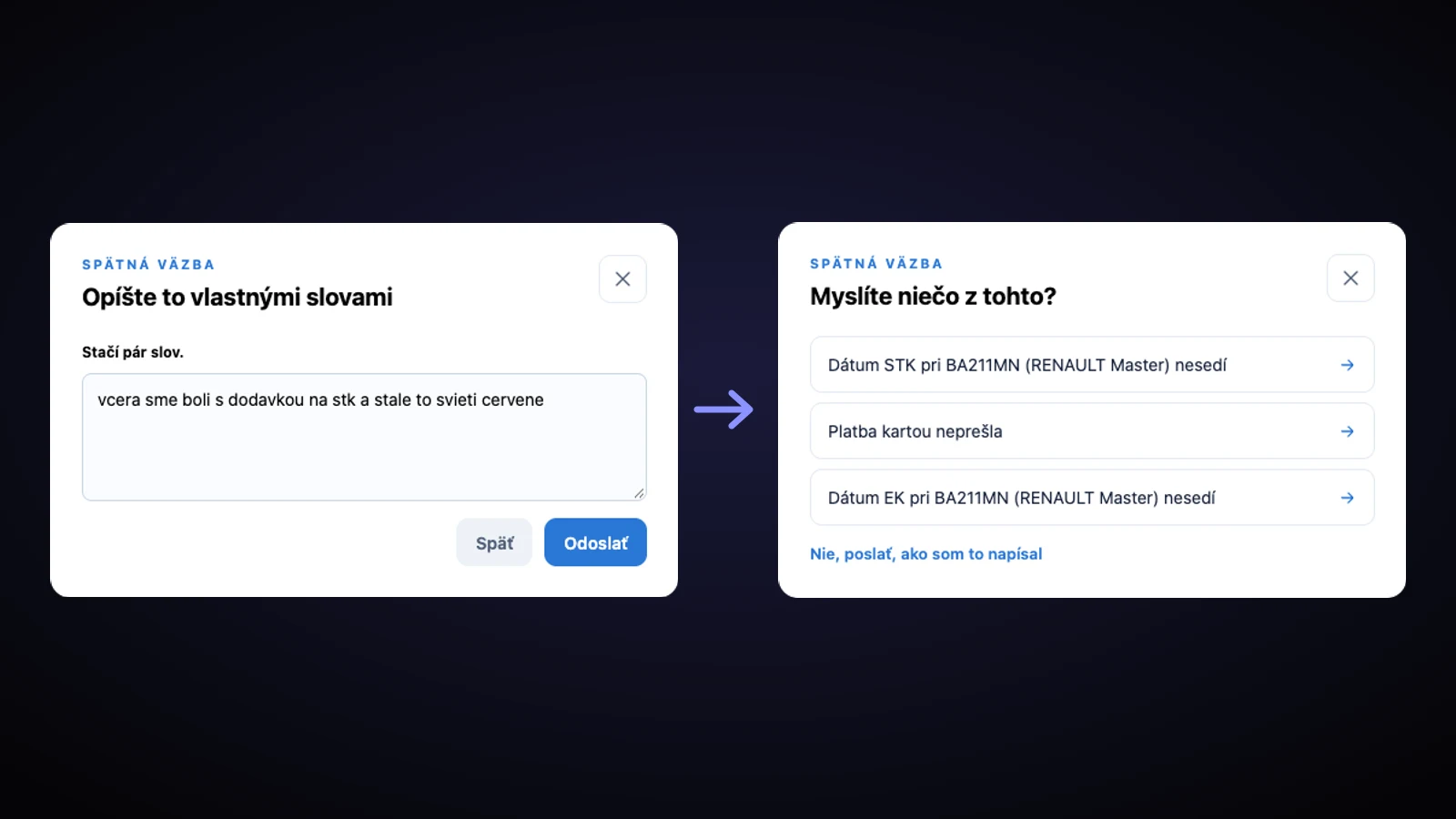
When a customer only clicks, the app can see what is going on, and plain rules are enough. When they type in their own words, rules fall short. That is where Jev comes in, a model by TypeSafe. It writes no text; it only picks from our options and says how confident it is.
What the AI does
- Ranks more than 50 causes by probability and says how confident it is about each.
- Understands colloquial Slovak without diacritics, with typos and roundabout wording.
- From the text, estimates which car the problem is about and whether the customer is angry.
- Helps sort the reports for support: a bug in the app, a sales opportunity, a feature idea.
What the AI does not do
- It does not compute deadlines. Whether a car is overdue is always decided by plain code.
- It writes no text. Everything the customer sees is written in advance.
- It never sees licence plates, names or emails. It gets cars as “car 1” and “car 2”.
- It triggers no actions. The customer always clicks the button.
- It does not replace a complaint or a contract withdrawal. Those have their own formal path.
- If it does not answer within 2.5 seconds, the rules assemble the suggestions on their own.
Results: rules, AI, or both?
Before launch we ran every version on the same 425 situations with a known correct answer. We measured whether the customer’s real problem was among the first three suggestions.
| Version | Only clicked | Typed in own words | Overall |
|---|---|---|---|
| The same list for everyone | 21% | 6% | 9% |
| Rules only | 97% | 72% | 81% |
| AI only | 71% | 94% | 93% |
| Rules and AI (deployed) | 97% | 92% | 94% |
Rules win when the customer only clicks. AI wins when they type. So both run at once and every option gets the average of the two.
These figures come from the pre-launch test. The customer texts were written by an independent AI model from short stories, not by real customers. That is why an A/B test runs in production: half of the companies get suggestions from rules only, half from rules with AI.
What the AI costs and how it feeds into the price
- One opening of the AI panel
- ≈ $0.0001
- A thousand openings
- $0.11
- Response time (median)
- 0.29 s
- Fallback without AI
- after 2.5 s
- One register check of a car
- as much as 40 to 120 openings
Expiro’s most expensive item is not the AI but the register data. On paid plans every car is checked daily and every check is paid for. That is why the price list, starting at €4.90 a month, is based on the number of cars and on the worst case of data consumption. The AI is a fraction of it.
Technology
- Web
- Next.js, Vercel
- API
- Fastify, TypeScript
- Database
- Supabase (PostgreSQL, Frankfurt)
- AI
- Jev (TypeSafe) via OpenRouter
- Payments
- Stripe
- Mobile (in progress)
- Expo, React Native
What is next
- A mobile app for iPhone and Android: add a car by photographing its licence plate and get deadline reminders as notifications. The “Something wrong?” button will be there too, with the same catalogue and AI.
- A/B test results from production. We will publish them even if they turn out different from the test.
- New causes in the catalogue, based on what customers type under “Something else”. The AI does not invent them; we add them.
Read more
- Rules or AI? When a plain decision tree is enoughIn the Expiro app we compared plain rules with an AI model on 425 situations. Where the rules won, where the AI won, why we deployed both at once and how to tell that your case does not need AI.
- How to test AI before your customers see itThe process we used to check the AI in the Expiro app before launch: 425 situations with a known correct answer, texts from an independent author, a comparison with a dumb version, confidence calibration, cost per thousand calls and an A/B test in live operation.
Want AI like this in your own product or support?
We will tell you where rules are enough, where AI pays off and what running it will cost. If you do not need AI, we will tell you that too.